Friday, August 15, 2008

The Forbidden Kingdom - a review


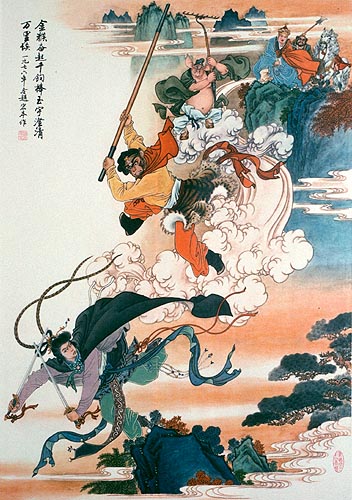
When Jackie Chan and Jet Li star together for the first time in a movie whose plot spans the heaven (the Chinese version of it) and Earth and 5000 years, you may expect something interesting. And The Forbidden Kingdom' (director: Rob Minkoff, Action :Huen-Woo Ping of Crouching Tiger, Hidden Dragon fame) lives up to the promise.

The story involves Jason (Michael Angarano) stumbling upon a mighty artefact from ancient days, the legendary staff of the Monkey King (Jet Li) - mystic, warrior, spiritual seeker, who is invincible and wise. The original story of the Monkey King is written in the Chinese legend, A Journey to the West, which is quite an interesting folklore and quite downloadable. There are strong parallels between his tale and that of Shri Hanuman. On his discovery, Jason is transported back to ancient China, where the Jade warlord, the commander in chief of heaven's armies and a sorcerer, has unleashed a reign of terror on the people and has imprisoned the Monkey King in stone. Jason meets Lu Yan (Jackie Chan), a drunken master and the venegance seeking sparrow girl (Yiefei Liu), and together the unlikely trio begin their journey towards the mountain of heaven and earth and the palace atop it where the Jade Warlord holds sway. On e way they run into adventures and misadventures aplenty, and a mysterious monk (Jet Li again) joins them in their quest.

The kung fu action is spellbinding, the camerawork excellent and the backdrops are visual treats. The plot, which is quite entertaining, could have been infinitely more engaging had the director retained the spiritual metaphors that are so abundantly present in the Monkey King's tale. The same can be said about the dialogues. Still, it is an interesting action flick and is definitely worth a watch.

Wednesday, August 13, 2008

The wonder of ancient Indian stories

Stories can evoke love, peace, excitement, thrill, joy, anger, pride, resentment, greed, jealousy, gratitude, generosity, lust, creativity, grandeur, despair and redemption. But in the ocean of stories that have been told over the ages, Indian puranas and itihaasas offer that rarest of gifts to the reader – they take him on a voyage of spiritual exploration, one that cleverly reveals the most profound knowledge of the creation and the universe.

The Indian literature and tradition is the longest unbroken chain in known human history. The rishis of ancient India, the greatest scientists of humanity, hid the gems of their invaluable knowledge in stories, anecdotes and historical records. Sanskrit, their lingua franca, is widely regarded as the mother of all languages and the most perfect language ever known to mankind. In the most perfect language, with the most perfect knowledge, the rishis created an immortal tradition of passing the greatest treasure of humanity, their knowledge. I say immortal because the same stories and traditions have been passed down thousands and thousands of years and generations. Even more remarkable is the fact that these traditions and stories were often modified through the influence of different times and attitudes, but their core, the spiritual knowledge, has remained intact and as profound and relevant as they were at the beginning of time.

Unfortunately, as English became the language of the Indian intellectual over the British Raj, and the British began to systematically destroy India’s spirit by purposely mistranslating and misrepresenting our heritage, generations of Indians were bereaved of the true wisdom that had survived all these millennia. (I would recommend a reading of the works of DK Hari and Francois Gautier to explore the facts. You can google their names.)

However, as the wheels of time have turned, we are witnessing a global reawakening of spiritual awareness. A new generation of Indian writers, more adept at English than the original English speakers, are now translating our Sanskrit texts into relevant, everyday prose that can be picked up at most leading bookstores.

Personally, I greatly admire the retelling done by Ramesh Menon. I am a happy and proud owner of his translations of the Mahabharata, the Ramayana, the Devi Bhagvatam and Krishna. I look forward to picking up a copy of the Shiva puraana once I am done with these.

The Mahabharata by Ramesh Menon comes in two volumes. On its jacket, are the words of Ved Vyas, the original narrator of this Mahakavya, stating that “What is contained herein is everywhere. What is not, is nowhere.” This is probably the best summary that comes to my mind after I went through the volumes, rapt. The epic characters embody every human virtue and flaw. The heroic pandavas, Krishna - the lord himself, the treacherous Kauravas, Karna – the antihero, Kunti, Dhritarashtra, Shakuni, scores and scores of other characters – humans, rakshasa, gandharvas, devas, rishis, yakshas, nagas - seem to live and breathe like they were right here. Reading their conversations and interactions is like witnessing the entire pageantry of human behavior passing before your eyes. The descriptions of the scenes blend astronomy, gemology, physics, philosophy, botany, zoology, architecture, and so many more sciences with poetry and beauty. The narrative sweeps you. The feeling of redemption at the end of the book is amplified by the fact that there is plenty of historical evidence supporting that the Mahabharata actually happened! Even Guruji openly proclaimed it to be true.

The Devi Bhagvatam deals with the most ancient of Indian folklore, tales of the very beginning of creation, of the first races of devas, asuras and men. In its pages, you will find physical descriptions of the events of the creation of the universe, its destruction along with timelines associated for each! It speaks of the hidden divinity that governs existence. The most ancient of mantras are mentioned here. Of course, there are plenty of stories about how the devi destroyed the most powerful of asuras, how the devas lived, along with tales of Vishnu. The sweep of the narrative across eras and characters is enormous.

Krishna delves into Krishna leela, his life story. It is written in a very interesting style with the focus shifting between two different arenas of action – the prakriti, or the circumstances that Krishna lived through - his life story, and the purusha, a description of what Krishna stood for. The purusha aspect is commonly known as the Bhagvat Gita.

I am yet to read Shiva and complete the Ramayana, but I can say that the Ramayana has been an engrossing read so far. Ramesh Menon has preserved the dialogues and has translated them faithfully. He has used his imagination and superb prose to set the pace and backdrops of the stories. The combination is mindblowing.

In a nutshell, his skilful translations have given us an opportunity to enjoy and discover the grandeur and vastness of ancient Indian tales. And they are cracking good reads. Go grab your copies today!

Tuesday, August 12, 2008

‘Confusion’ keeps volunteers locked in


The Monday morning TOI carried this story about how KK and Amrita were locked in at Bangalore’s famous Christ college. The article claimed that ‘confusion’ kept our volunteers locked in at Christ college. This is an unprecedented event in history. As the newspaper did not elaborate much on how ‘confusion’ locked in KK and Amrita, we may, for the time being, assume that the warden at the Christ college's girls hostel did so.

Here is the actual account. At 9.00 pm on Saturday evening, Amrita and KK entered the Chirst college campus to register a participant in the Girl’s hostel for Utsav and to speak to a few students about the course. They went in without incident and when they were leaving the warden confronted them asking where they were going so late. So KK and Amrita described the situation to her. At the mention of the Art of Living, the warden panicked and immediately began to threaten the two girls even saying things like “the official time for meeting guests is between 6.30 pm – 7.00 pm”. She conveniently forgot to mention that she had given the oral consent for our volunteers to visit their campus. Usually such circumstances would result in strict remonstration followed by letting the volunteers leave but the warden forcibly detained them overnight without their consent. She even tried to confiscate their mobile phones, which KK and Amrita bravely refused to concede to. The girls, were so caring even in their predicament, that they were ready to go back in the morning without disturbing anyone lest they create unnecessary panic.

It was in the morning that the authorities showed their true colors. Even at 9.30 am the girls were not being allowed off the campus. Realizing the gravity of the situation, KK called up Bau and Dinesh Bhaiya, who promptly guided Devang and Guruprasad, one of the senior members of our YES+ team in Bangalore, to handle the situation. Guru called me and I contacted some of our senior Art of Living faculty who also rushed to the college. At first the security would not let us in, but he relented when we told him that either he let us in or we call the police. 5 of our senior teachers and volunteers, Radhika Ji, Santa uncle, Smita didi, Guruprasad and later Uchil uncle went to discuss the issue with the warden. In the meantime, as per Dinesh Bhaiya’s instructions, all Bangalore YES+ volunteers were informed and urged to come to the gates. In less than an hour, by around 12 pm, we had more than 100 YES+ team members at the gates of Christ college. The discussions were underway inside, and Savitha one of our journalist devotees had even got the crew from Times now at the college gates. At 12 pm we discovered that the girls had still not been offered food and water and we rushed to get something for them. The security, who had come to their senses by then by seeing the congregation outside the gate, were still a little hesitant to let us in but we marched ahead. We later discovered that Amrita, who had informed the warden that she needed to eat before her medicines had been denied food till then, and had fainted. It was only then that the authorities at Christ college brought them idlis. Till about 2pm, our representatives inside were kept waiting, while the Father at Christ college, unmindful of the girls’ condition, took his own time getting to the campus. Finally, at about 4.45, the girls were let off and they described their plight in an interview immediately afterwards.

Is it justifiable to lock up two adults without their consent when they pose no threat? Even our jails offer food and water to the inmates, but ‘Christ’ college would not do the same for two girls who posed them no threat. None of the girls’ families were informed. The warden kept changing her statements every 5 minutes in the discussion with out people and we could gauge that she had no logical reason for her actions.

In contrast to their attitude, our volunteers and teachers, who had rushed to the campus as soon as they heard the news, consulted the senior authorities in the government and the Apex body to quickly prepare the best course of action. There was no commotion or disturbance created at the campus gates, and the police who had been called to ‘control’ the situation looked about rather foolishly on what to do with a bunch of people meditating outside a college gate. We even joked to each other that this was the biggest YES+ volunteers meet we have had in Bangalore till date. After much discussion and deliberation till late night, we decided to not take legal action against the college authorities because we have had cordial relations with them in the past.

Now, Jesus Christ embodied love, forgiveness and total compassion. It is surprising that the people who built an eduational institution in his name seem to completely miss the point. Clearly, these values reflected in the actions of the other party completely.
PS: Here is another article on the same event

Tuesday, July 22, 2008

Pasta and Maths with the Rishis


Good things often come to you without notification. If you are a devotee they come frequently and always without warning. And because opposite values are complementary, they are usually preceded by some frantic bursts of crazy running around, desperate phone calls, roller coaster emotions and fervent prayers. If you like a well defined, surprise-free life (i.e. you have not done the YES+), you would probably be wondering what these lines meant. If you love your life, like crazy adventures and care for the planet (i.e. you have done the YES+) you would be right at home with the above.
Yesterday was one such day - Vishal's fateful phone call at 4 pm went "Bawa is coming to Koramangala at 7. Get 40 people" This was followed by 2.5 hours of frenetic phone calls, cajoles, threats, and other means of persuasion in different parts of bangalore. Only 20 blessed souls made it to the venue though. Then came the rishis - both Bawa and Dinesh, their glows lighting up the Indian Heritage Academy.
The mathemagic session was brilliant. One answer in particular stood out highlighting Bau's total presence of mind and depth of wisdom. Bawa was 100% teaching the topic of countable infinity and uncountable infinity. In short, an infinite number of distinct things become countable infinity. An infinite number of things where infinite other things exist between any 2 things is uncountable infinity. A question asked was that In any situation, human beings have only a countable number of choices they may make - hence countable infinity. Yet why is it said in books of wisdom that we have infinite possibilities in any situation (uncountable infinity)?

The answer was sheer genius. Look at the diag ram here. Bawa said that most people believe themselves capable of doing only a certain number of things. Hence their choices are countable, bound within a small solid circle of possibility as shown. When you get enlightened, this barrier breaks and you are capable of anything! Lke Guruji :) Hence enlightenment is the transition fom countable to uncountable infinity, and meditation is the way.
The joyous mental exercising left us pleasantly hungry, and we proceeded to Via Milano, one of Bangalore's most promising Italian eateries, for dinner. Now Via Milano is known to be a slightly elitist place, where people are so proper. When our YES+ group walked in, it was as if the place had come alive suddenly. It felt much more warm and comfortable. Carl, the restauraneur who owned the place was a gracious host and we had splendid vegetarian choices, which could have been better had they stocked whole-wheat pastas instead of maida ones. We had an assortment of yummy italian salads, tailormade to Baus impeccable tastes, with potato and mushroom soups, special mozarella fritters and 3 gobsmacking authentic thin crust veggie pizzas. This was follwed by the main course of assorted pastas, lasagnes each spiced perfectly and accompanied by flavored olive oils. The pannacotta dessert ws superb. Our verdict was that the place would be a definite go-to if they serve whole wheat pastas, which Carl has promised to do if he is called in advance. Of course we had lots of photos, lots of laughter and it was amazing to see how Bau and Dinesh bhaiya seem to be so effortless and natural wherever they are. It seems that their sorroundings blend into them rather than they blending into their sorroundings. Dinesh bhaiya cracked a couple of sardar jokes, Bau gave Carl pointers to improve his delightful cuisine, and we all retuned happy, glowing and well fed.
The icing on the cake was that Dinesh Bhaiya was so gracious, he sent a message thanking us all after the dinner. Praying to have diner with them really soon:)

Wednesday, July 16, 2008

Born Again


Have just returned from an experience called the TTC. A 111 of us were battered (our egos specially on the first 5 days), kneaded (with yogic postures designed to turn the best of backs to jelly), doused (with tough challeneges), sieved (through intro talks) , marinated (with knowledge points) , baked (through establishing the knowledge points and by buddha's grace), and once done, properly topped with cherries and fruits (the graduation party, the artificial meat dinner). Guess all of it is necessary so that we can have a pudding (us) worthy of the filling (the SK notes, the tape)....

Some dishes are meant to get better with time, so we work and wait for our manuals, after which we are ready as irresistible, mouthwatering, heartfilling offerings called YES+ teachers, out to entice and uplift an entire populace. Jai Gurudev!

Monday, June 16, 2008

Indian blues and Redemption Song


As Shahrukh Khan sings
“Kabhi to tumko chhatri de dein jab barse pani,
Kabhi naye packet mein bechein tumko cheez purani,
Phir Bhi Dil hai Hindustani”

It is this maddening juxtaposition of two polar extremes which makes us so unpredictable, so Indian. We can deliver lectures on Gandhivaad and self-restraint and then fall over each other to grab a local celebrity’s autograph. A cop may glare at you for breaking out of line at the traffic signal but then salute you the moment you slip him a 50 note. Our own daily lives are full of such extreme opposites (Father being late for work then teaching son about punctuality in the evening, Beautifully decked up ladies punching without abandon to board local trains, Vehicles running casually over animals on the highway on the way to home carrying their beloved child’s gift).

We have institutionalized self-abasement, jealousy, blatant materialism, opportunism – inspite of having the best spiritual tradition in the World. The biggest comedy occurs when harried ‘baratis’ slip the priests additional notes to ‘appease’ the Gods faster. As if God was that stupid.

Let us be clear on one thing, we lack nothing – except compassion and respect for other Indians. All our national problems are self-inflicted including our Government. After all, they only practice the Indianised arts of self-contradiction, denial and laziness at the highest echelons of power. How can any Indian feel indignant, righteous anger at ‘others’ in the society without having a good look at himself/ herself? How can we continue to fill the coffers of polarized bigoted channels of news proudly parading themselves in the garb of ‘national news networks’? How can we not care about the gross inequality that we inflict upon ourselves?

The only solution that we have in front of us is ‘Active Acceptance’ – facing the problem and resolving it with a big heart, generosity, acceptance and compassion. As Bonaparte would say “Iron Fists in a Velvet Glove”.The dust is only surface deep. One touch of the Sudarshan Kriya would open up our hearts which we have for so long not expressed.

As LK Advani said in the Silver jubilee celebrations of the Art of Living in Bangalore, “Such a huge international congregation defies understanding. This great son of India (Guruji,His Holiness Sri Sri Ravi Shankar) has done us proud and He is the one true hope we have of establishing Sanatan Dharma and Vasudhaiv Kutumbakam.”
Hinduism, in its true essence, offers a true solution through universal acceptance and brotherhood – for India and for the World, for Love moves the World.

Friday, June 13, 2008

Vegetarians Forever!


Wishing the whole world celebrates 'V' day every day. Not the mushy shiv-sena attracting variety, but one marked by the crisp crunching sound of fresh veggies. A 'Vegetarian' day i propose every day.

Why should others bother to go vegetarian?
1. You further humanity. For all those who disagree, the production of non-veg food consumes 30 times more resources than equivalent vegetarian food.
2. You protect animalkind. If you disagree go watch 'Meet your Meat' on goveg.com. No living creature, except a few people i unfortunately know, deserve that kind of treatment.
3. You save the Earth. The pollution from the non-veg-food-industry rivals that of all automobile and industrial pollution combined.
4. You live longer. Colon cancer, obesity, heart disease all are , on an a verage, 20 times more likely to afflict a non-vegetarian than a vegetarian
5. You help a fellow human being (aka me). Who do you think pays taxes for all that subsidized chicken - other vegetarians of course!

ShareThis